Sign in
Home
How Automation Is Changing LNP Formulation Screening
By Joshua Gomes
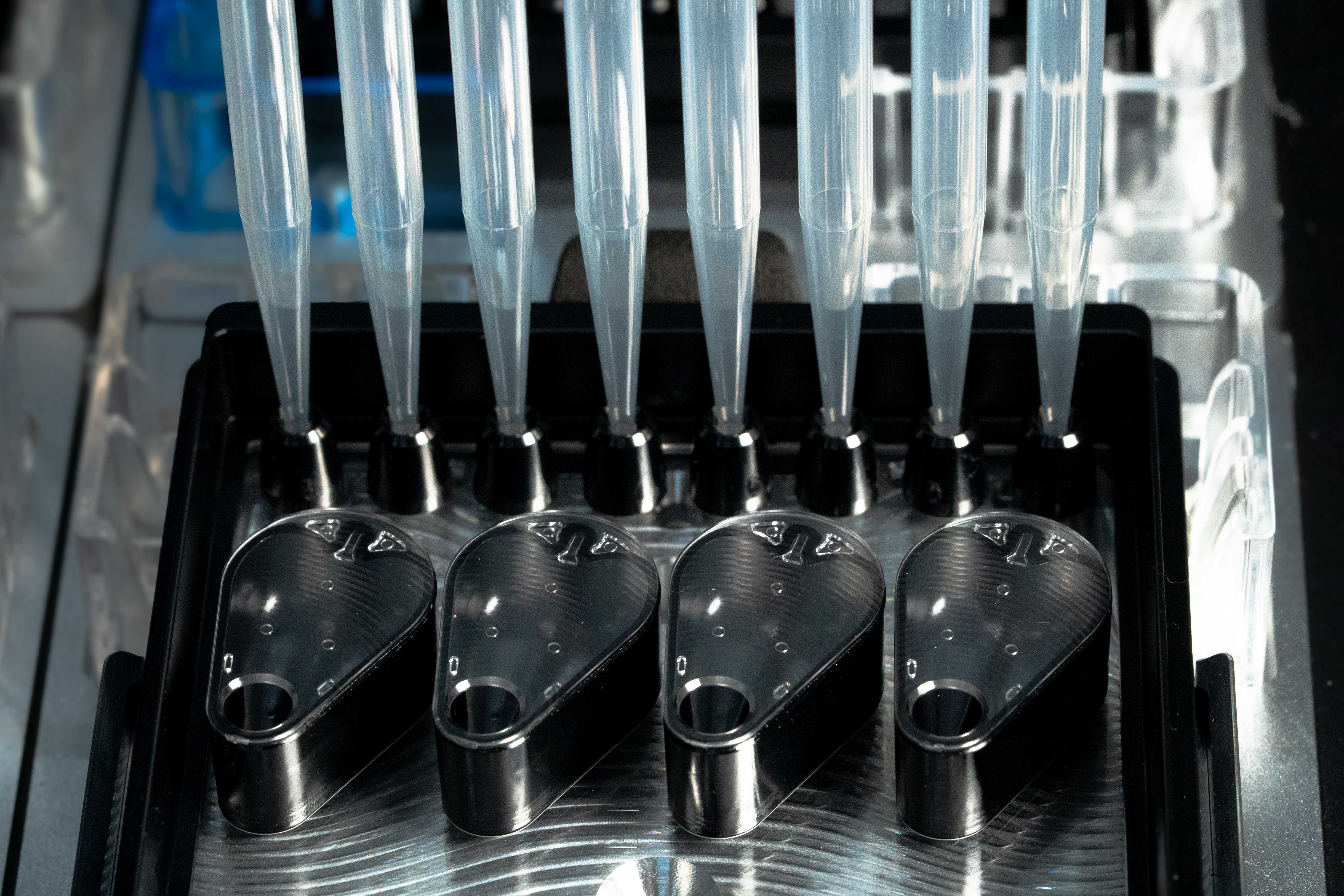
Formulation has been one of the hardest steps of an LNP screen to automate. Bringing microfluidic formulation onto the deck of a standard liquid handler enables each formulation to be produced in seconds.
Formulation is one of the hardest screening steps to automate
Liquid handlers can automate plate-based steps of an LNP screen process, such as dilution, RiboGreen assay preparation, and dynamic light scattering (DLS) plate preparation, because each one comes down to accurate volume transfers between plates.
Formulation is harder to automate because consistent LNP synthesis requires rapid, controlled mixing that pipetting alone does not deliver. Until recently, automating formulation meant buying a dedicated benchtop instrument or accepting the limits of pipette mixing.
| Screening step | What automation requires | Achievable with standard pipetting |
|---|---|---|
| Dilution | Accurate volume transfers | Yes |
| RiboGreen assay preparation | Accurate volume transfers and reagent addition | Yes |
| DLS plate preparation | Accurate dilution into measurement plates | Yes |
| Formulation | Rapid, controlled mixing of the lipid and aqueous phases | No |
Leading benchtop systems produce 10 to 20 formulations per hour
Benchtop formulation systems brought controlled microfluidic mixing to LNP screening, but on an instrument separate from the liquid handler. Single-sample instruments such as the NanoAssemblr Ignite produce about 10 formulations per hour, with an operator loading inputs and collecting each sample by hand. Automated benchtop systems such as Unchained Labs Sunscreen reach 15 to 20 formulations per hour but must clean the mixing path between formulations.
Both run as separate instruments, so formulated samples are collected by hand before dilution and characterization.
| Workflow step | Single-sample instrument | Automated benchtop system |
|---|---|---|
| Example | NanoAssemblr Ignite | Unchained Labs Sunscreen |
| Formulations per hour | About 10 | 15 to 20 |
| Loading inputs | By hand for every formulation | By hand for every batch |
| Between formulations | Operator collects the sample and loads the next run | Mixing path cleaned before the next formulation |
| After formulation | Each sample collected by hand | Each batch collected by hand |
Pipette mixing trades particle control for speed
Some labs formulate on the deck with pipette mixing, using the liquid handler’s own tips to combine the lipid and aqueous phases in a well. Formulation then stays inside the automated method, with no transfer to a separate instrument.
A 2026 ACS Nano study on automated LNP library generation identifies pipette mixing on liquid handlers as a source of batch-to-batch variability in LNP size. Labs have had to choose between formulating quickly on the deck and controlling particle formation on a benchtop instrument. Pipette Mixing vs. Microfluidic Mixing for LNP Screening examines that tradeoff in detail.
| Consideration | Benchtop formulation system | Pipette mixing on the liquid handler |
|---|---|---|
| Where formulation runs | Separate instrument | Liquid handler deck |
| Particle control | Controlled microfluidic mixing | Varies with tip type, mixing speed, and cycle count |
| Sample location after formulation | On the benchtop instrument | In a plate on the liquid handler deck |
Microfluidic formulation now runs on the liquid handler
On-deck microfluidic formulation resolves that tradeoff by placing a microfluidic consumable in a standard deck position, which gives the liquid handler controlled mixing without a separate instrument. The liquid handler dispenses the lipid and aqueous phases through the consumable with its own pipette tips, and each formulation collects on deck.
Each formulation takes seconds, and the liquid handler moves straight to the next formulation with no cleaning or cartridge change. Throughput rises from 10 to 20 formulations per hour on leading benchtop systems to 100+ formulations per hour on the liquid handler. Speed is one of several criteria for an automated formulation workflow, alongside particle quality and keeping samples on deck for the next step.
| Consideration | Benchtop formulation system | On-deck microfluidic formulation |
|---|---|---|
| Formulations per hour | 10 to 20 | 100+ |
| Between formulations | Cleaning or manual sample handling | Liquid handler moves to the next micromixer |
| Sample location after formulation | On the benchtop instrument | On the liquid handler deck |
| Next step | Manual transfer from the instrument | Can continue in the same method |
Screen more of your lipid library in every round
Faster formulation lets each screening round include more lipids, molar ratios, and replicates without adding operator time between formulations, so the scope of a higher-throughput screening workflow is set by the lipid library rather than instrument capacity.
A lipid library that once had to be split across several rounds can now be screened with full replicates in one, so every lipid is compared within the same round.
| Round design | Benchtop formulation system | On-deck microfluidic formulation |
|---|---|---|
| What limits round size | Instrument capacity and operator time | Lipid library and reagents on deck |
| Adding lipids or molar ratios | Adds instrument runs | Adds reagents to the method |
| Adding replicates | Adds instrument runs and hands-on time | Adds micromixers on deck |
| Operator time between formulations | Required for every formulation or batch | None |
Formulate on your liquid handler with the LNP Screening Array
The LNP Screening Array brings microfluidic formulation onto standard liquid handlers, with automation protocols configured for air-displacement, positive-displacement, and pressure-controlled pipetting. Each LNP Screening Array holds eight independent micromixers in an SLAS microplate format and occupies one standard deck position.
Running multiple LNP Screening Arrays in one method brings a screen to 100+ formulations per hour. Each formulation collects on deck, and dilution and assay preparation can be added to the same method.
| Screening need | How the LNP Screening Array meets it |
|---|---|
| Formulation speed | Each formulation produced in seconds |
| Throughput | 100+ formulations per hour with multiple LNP Screening Arrays in one method |
| Liquid handler compatibility | Protocols for air-displacement, positive-displacement, and pressure-controlled pipetting |
| After formulation | Samples collect on deck, with dilution and assay preparation available in the same method |
Bring LNP formulation onto your liquid handler
Tell us which liquid handler you run and what your next screen needs, and we will show you how formulation fits into the method you already use.