Sign in
Home
LNP Screening Array vs. Elveflow LNP Synthesis Pack
By Joshua Gomes
Elveflow’s Lipid Nanoparticle Synthesis Pack is a kit of pressure controllers, flow sensors, and reusable chips that labs assemble themselves, while the LNP Screening Array runs on your existing liquid handler and produces each formulation in seconds.
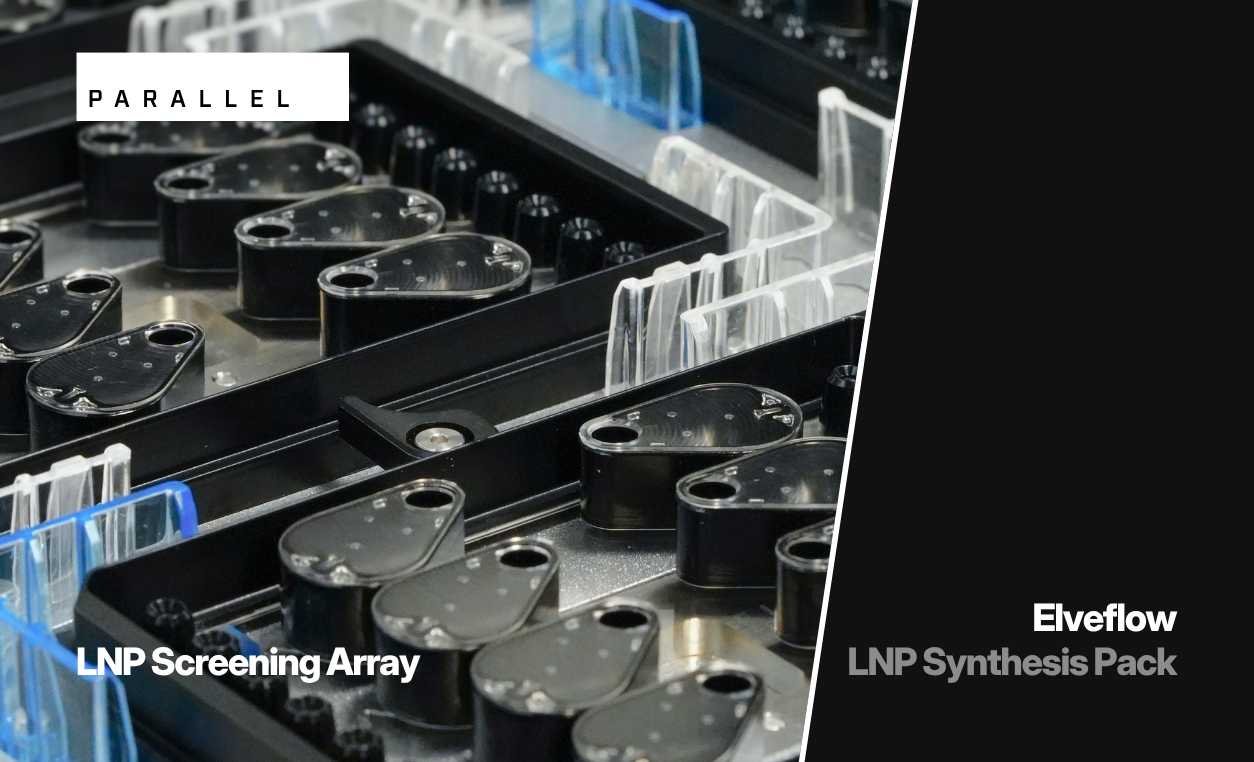
LNP Screening Array vs. Elveflow LNP Synthesis Pack
Elveflow’s Lipid Nanoparticle Synthesis Pack ships as separate components, including an OB1 pressure controller, two flow sensors, two reusable herringbone mixer chips, sample reservoirs, and tubing. The lab assembles those parts into a pressure-driven formulation setup, connects the controller to a pressure source it provides, and runs the system from Elveflow’s ESI flow-control software. Elveflow itself labels the pack a “homemade/custom system” in a comparison table that sets it against TAMARA, the dedicated instrument from its exclusive LNP partner, Inside Therapeutics.
The LNP Screening Array replaces that assembly with a single microfluidic consumable. Its eight micromixers sit in one standard deck position on the liquid handler already in your lab and produce each formulation in seconds.
| Comparison | LNP Screening Array | Elveflow LNP Synthesis Pack |
|---|---|---|
| Format | Microfluidic consumable | Kit of pressure control, flow sensing, and chip components |
| Assembly | None | Controller, sensors, reservoirs, tubing, and chips assembled by the lab |
| What drives flow | Liquid handler pipette tips | OB1 pressure controller and a lab-supplied pressure source |
| Formulations per hour | 100+ | < 20 |
| Minimum formulation volume | 100 µL | About 1 mL |
| Changing lipids or cargo | Drawn from reagents on deck by the liquid handler | Reservoirs swapped by hand, or a separate valve pack added |
Start screening without assembling a pressure-driven setup
Setting up the pack means building a fluidic system before the first formulation. The pack’s user guide walks the lab through installing the ESI software, connecting the OB1 to a dry, oil-free pressure source at 8.5 to 10 bar, cutting tubing to length from about 50 m of supplied stock, and entering custom calibration values for the ethanol flow sensor.
Elveflow’s own product page lists “complex setup, not beginner-friendly” and a “steep learning curve” among the pack’s drawbacks, and the user guide warns that air bubbles, leaks at the chip connectors, and clogging can each disrupt a run.
The LNP Screening Array occupies a standard deck position and connects through standard pipette tips, with no tubing to cut, no flow sensors to calibrate, and no pressure controller to connect. Our team configures and installs the protocol for your liquid handler, so a lab can run microfluidic formulation without a microfluidics engineer.
| Setup task | LNP Screening Array | Elveflow LNP Synthesis Pack |
|---|---|---|
| Pressure source | None | Supplied by the lab, 8.5 to 10 bar recommended |
| Tubing | None | Cut and routed from 50m of supplied stock |
| Flow sensors | None | Two sensors calibrated separately for water and ethanol |
| Software | Your liquid handler's existing software | Elveflow ESI software |
| Connection to the mixer | Pipette tips seal directly to each micromixer | Fittings connect tubing to each chip |
| Formulation protocol | Configured for your liquid handler and installed by our team | Flow rates and control settings tuned by the lab |
Generate each formulation in seconds
The pack makes one formulation per run through a reusable chip, and the lab changes over between samples by hand. Before collecting the next sample, the user guide gives two options, discarding the rest of the previous sample to waste, which the guide notes does not prevent cross-contamination, or swapping in ethanol and water reservoirs and flushing the system clean. Elveflow’s comparison table lists a longer run time and lower reproducibility for the pack than for TAMARA, which it rates at up to 20 formulations per hour, placing the pack below that rate.
The LNP Screening Array produces each formulation in seconds with no chip to clean, supporting 100+ formulations per hour.
| Speed and consistency | LNP Screening Array | Elveflow LNP Synthesis Pack |
|---|---|---|
| Time per formulation | Seconds | Minutes, not including reservoir changes and purging between samples |
| Between formulations | Next formulation starts immediately | Previous sample purged to waste, or the system flushed with ethanol and water |
| Reproducibility | Z-average variability below 3% CV | "Lower reproducibility," in Elveflow's own comparison |
Use less RNA in every formulation
Elveflow lists a minimum formulation volume of about 1 mL for the pack, with losses of at least 300 µL per run.
The LNP Screening Array makes formulations as small as 100 µL, a tenth of that minimum, with less than 50 µL of dead volume.
The volume the pack needs for one formulation makes at least six on the LNP Screening Array, so the RNA budget for a screen stretches across at least six times as many lipids, molar ratios, or replicates. That matters most early in a program, when custom RNA and newly synthesized lipids arrive in small lots.
| RNA budget | LNP Screening Array | Elveflow LNP Synthesis Pack |
|---|---|---|
| Minimum formulation volume | 100 µL | About 1 mL |
| Volume lost per formulation | < 50 µL | > 300 µL |
| Formulations per 1 mL | At least 6 | At most 1 |
Switch lipids and cargo automatically between formulations
On the pack, each new lipid mix or cargo means swapping reservoirs by hand and purging the previous sample from the system. Automating input changes requires Elveflow’s separate Liquid Handling Pack, which adds a rotary valve, pressure controller, flow sensor, and software to switch between up to 12 samples, all of which still run through the same chip.
With the LNP Screening Array, the liquid handler draws the lipid and cargo for each formulation from reagents on deck, so a full lipid library runs against several cargos without a single reservoir change. The number of inputs is limited only by space on the deck, with no valve to add or program.
| Screening task | LNP Screening Array | Elveflow LNP Synthesis Pack |
|---|---|---|
| Change the lipid mix | Automated by the liquid handler | Reservoir swapped by hand, and previous sample purged |
| Change the cargo | Automated by the liquid handler | Reservoir swapped by hand and previous sample purged |
| Inputs available without manual changes | Every reagent loaded on deck | Up to 12, with the Liquid Handling Pack added |
| Added hardware for automated changes | None | Rotary valve, pressure controller, flow sensor, and software |
Replace the pressure-driven setup with the LNP Screening Array
Each LNP Screening Array holds eight independent micromixers in one SLAS microplate-format consumable. A 96-well-aligned port layout gives pipette tips direct access to every micromixer, and each formulation collects in its own anti-backflow reservoir, ready for the next step in your screen.
Formulation runs within your liquid handler’s existing software, with no separate flow-control program to learn. How the LNP Screening Array Works walks through each step on deck.
| Component | What it replaces in a pressure-driven setup |
|---|---|
| Eight micromixers per LNP Screening Array | Reusable chips connected, purged, and cleaned by the lab |
| 96-well-aligned port layout | Tubing and fittings routed to each chip |
| Pipette interface | Pressure controller, pressure source, and flow sensors |
| Anti-backflow reservoir | Manual sample collection at the chip outlet |
Find out how the LNP Screening Array fits your liquid handler
Tell us which liquid handler and lipids you work with, and we will walk through what your screen would look like on the LNP Screening Array.